Add Prescribing to Your Product
Your AI already knows what the patient needs. The next step requires a physician. This guide compares the three ways to add real prescribing to an app.
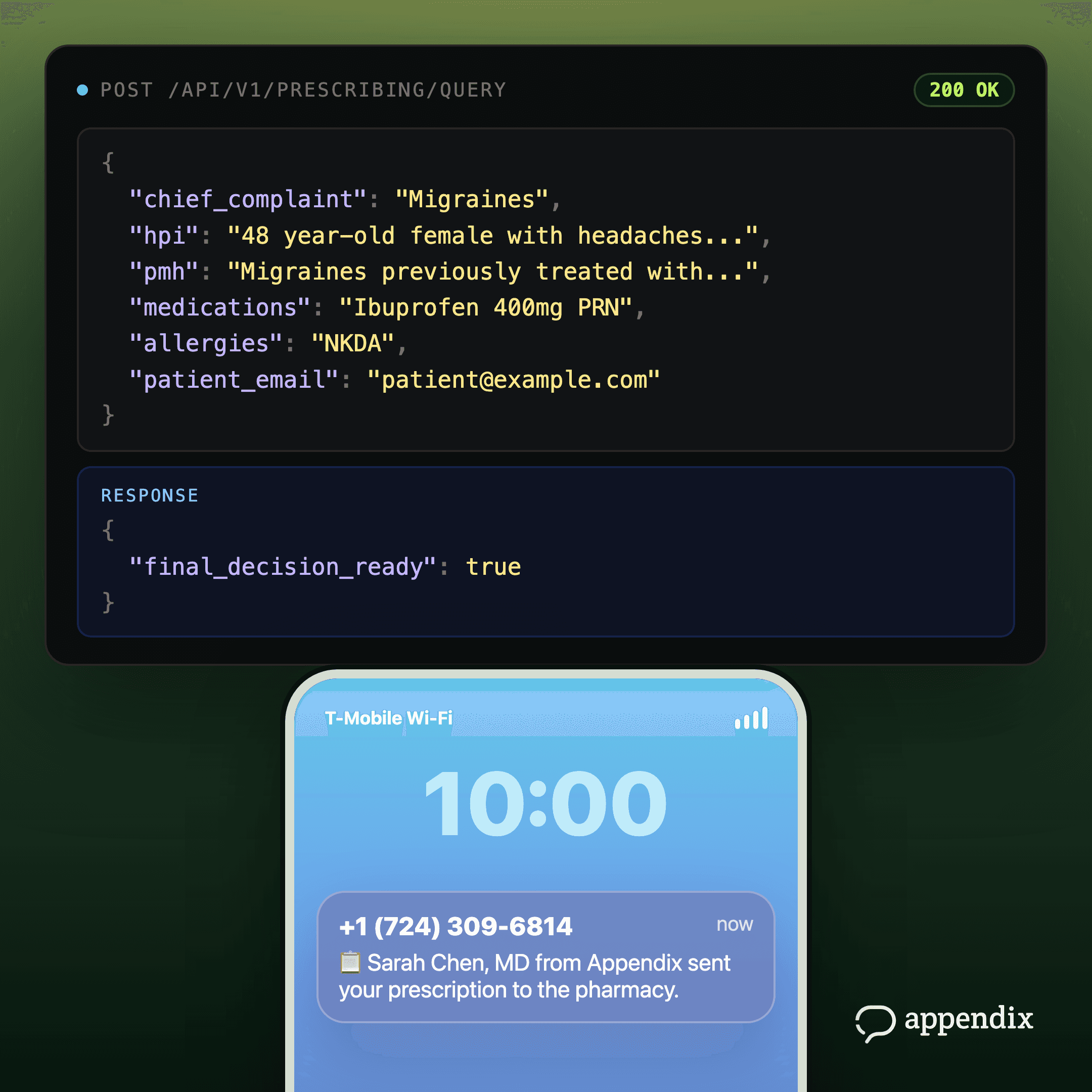
Why apps hit this wall
Symptom checkers, care-navigation tools, lab-interpretation products, and AI health assistants all reach the same point: the software has done the clinical reasoning, and the patient flow stops, because acting on it — writing a prescription — requires a licensed physician.
Until recently there were two options: stand up your own MSO/PC (the “friendly PC” structure) and hire clinicians, or sign an enterprise contract with a clinical staffing platform. A prescribing API is the third option: keep your product, and add the physician as an API call.
The three ways to add prescribing
Recruit licensed clinicians in every state you serve, stand up the MSO/PC (“friendly PC”) corporate structure, wire up e-prescribing, and run clinical operations forever. Months of work and red tape before the first prescription.
A clinical staffing platform provides the clinician network and virtual-care infrastructure under your brand. Reached through an enterprise sales cycle and an implementation project: clinician training, record-system integration, launch measured in quarters.
Your app sends a clinical summary to the API. A board-certified physician reviews it and prescribes when appropriate. You get the outcome by webhook. Self-serve sandbox today, production after review — no sales call.
| Build your own | White-label telehealth | Prescribing API | |
|---|---|---|---|
| Time to first prescription | Months | Quarters | Days |
| Getting started | Hiring and legal work | Sales cycle + implementation | Self-serve sandbox key |
| What you operate | The entire clinical practice | Your program on their platform | Just your product |
| Pricing shape | Payroll + overhead | Enterprise contract | Per completed review |
How a prescribing API works
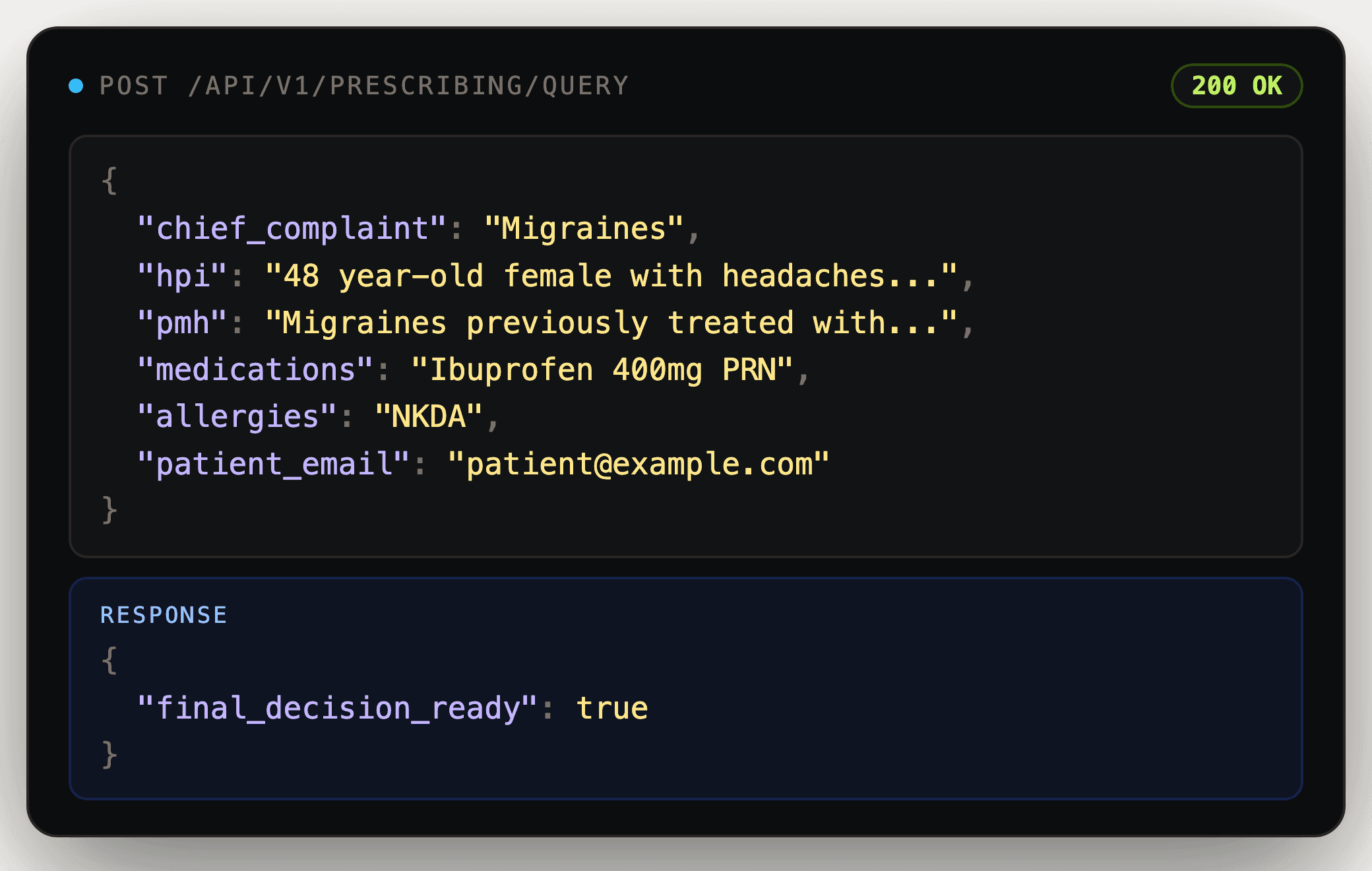
- 1Send a clinical summary
Your app POSTs the encounter — chief complaint, history, medications, allergies — to the API. If the summary is incomplete, the API tells you what's missing before anything reaches a physician.
- 2The patient consents
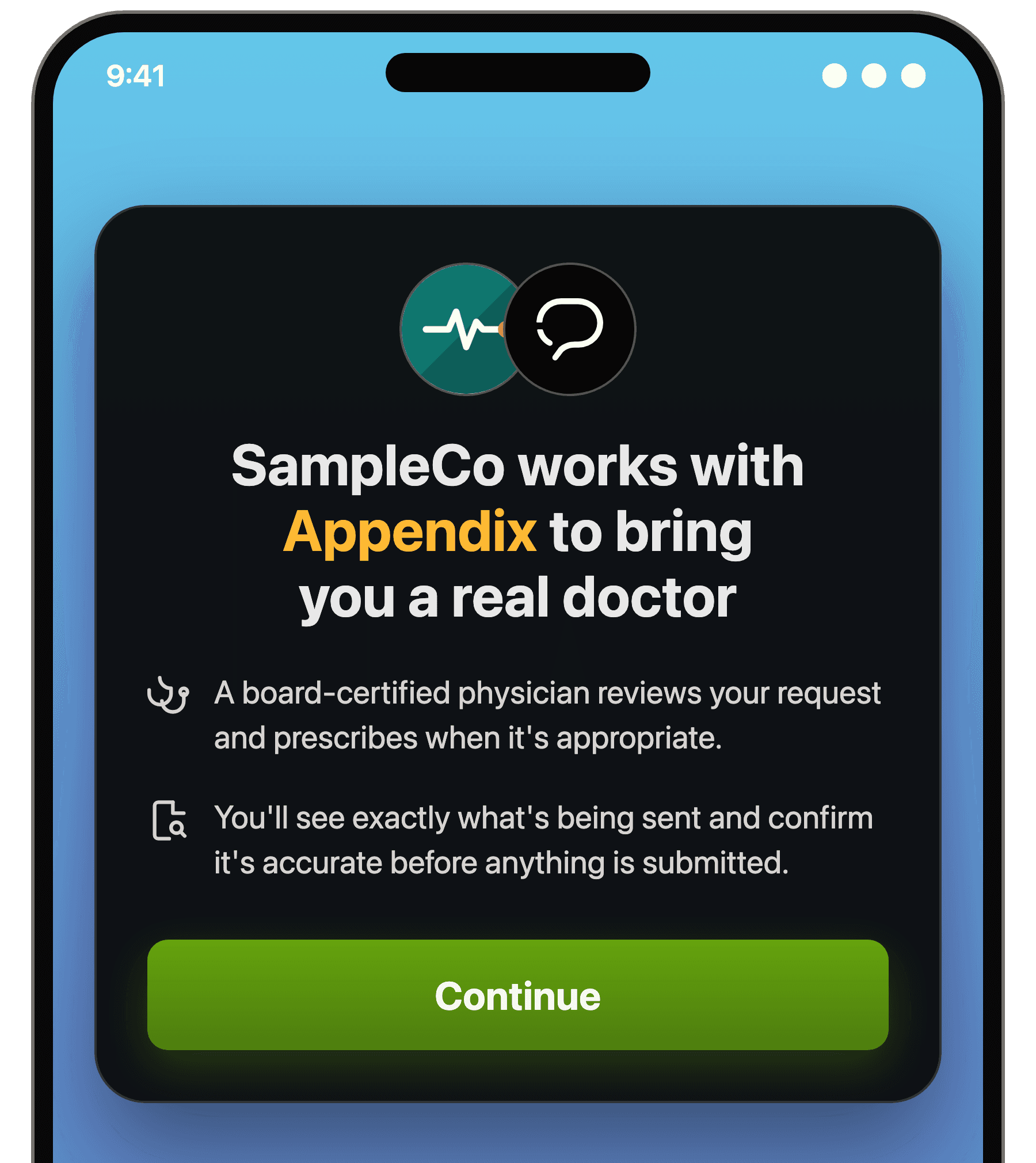
Your user approves the request on an OAuth-style consent page hosted by Appendix and verifies their identity. Enterprise organizations that obtain and document consent through their own intake can create patients via API and skip this page.
- 3A physician reviews
A licensed, board-certified U.S. physician reviews the submission — and can message the patient with follow-up questions when needed. Every request gets individual physician judgment.
- 4The prescription is sent
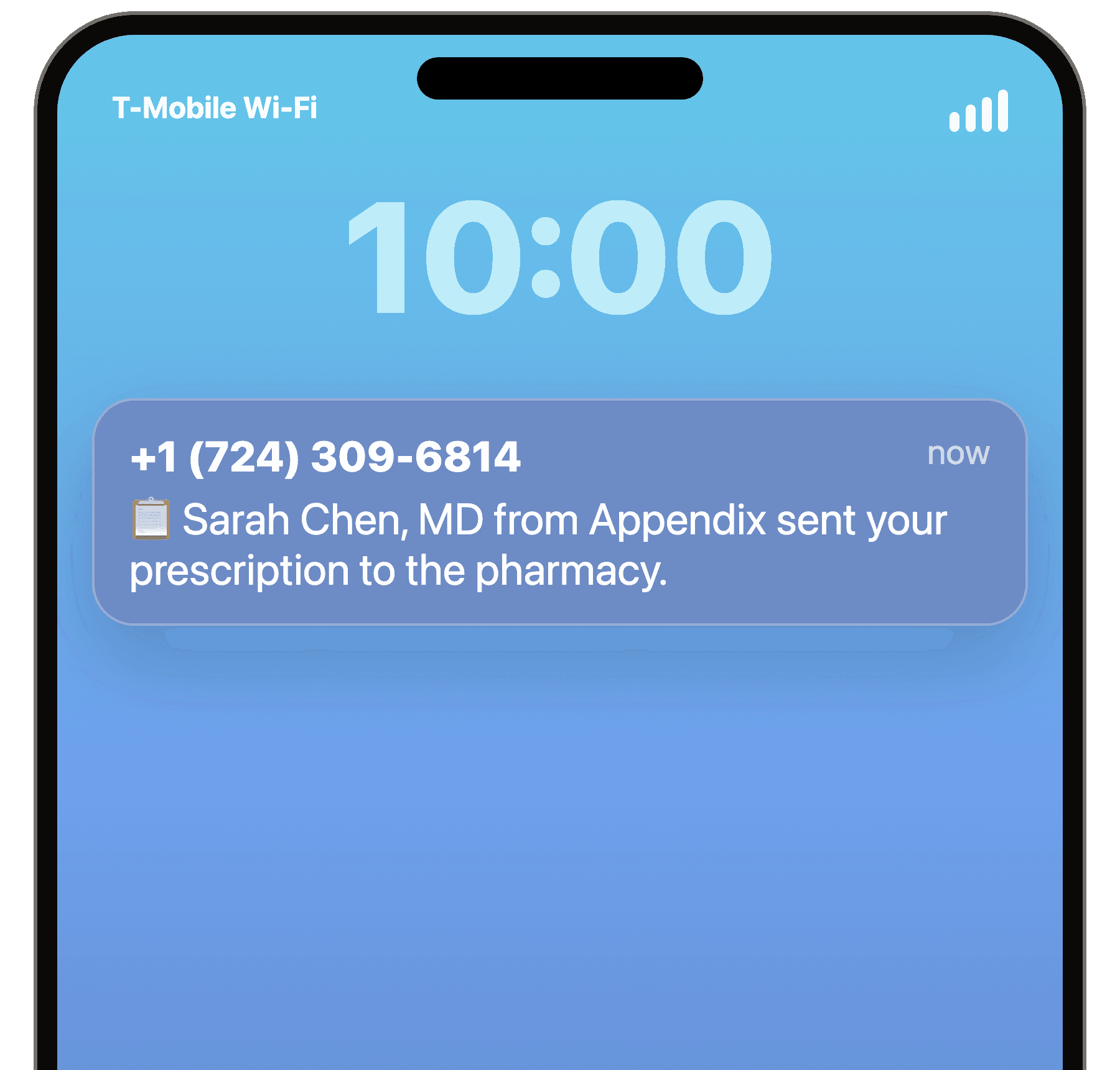
When a prescription is appropriate, it's e-prescribed and the patient picks their pharmacy — any pharmacy in the U.S.
- 5Your app gets the outcome
A signed webhook (plus a polling endpoint) reports the outcome to your app: status, prescription count, and whether a physician message is waiting.
What you don't have to build
Frequently asked questions
Do I need to hire doctors or stand up an MSO/PC (friendly PC) to add prescribing to my app?
No. With a prescribing API, the API provider is the medical practice — you don't form an MSO/PC or "friendly PC" structure, and you don't hire clinicians. Appendix employs board-certified U.S. physicians who review each request your app submits and prescribe when medically appropriate. Your product integrates by API; you never recruit, credential, or schedule clinicians.
How long does it take to integrate a prescribing API?
A working sandbox integration typically takes a day: self-issue a free test key, send a clinical summary to the API, and receive a simulated physician decision. Production access is granted after a review of your use case. Compare that with standing up your own clinical operation (months of work and red tape) or an enterprise white-label implementation (typically quarters).
Who actually writes the prescription?
A licensed, board-certified U.S. physician at Appendix. Every request is individually reviewed by a physician, and a prescription is written only when the physician judges it medically appropriate. Appendix does not prescribe controlled substances.
How does patient consent work?
In the standard integration, your user approves each request on an OAuth-style consent page hosted by Appendix, consents to care with Appendix directly, and verifies their identity. Organizations that obtain and document patient consent through their own intake can use the enterprise integration instead, which creates patients via API and skips the hosted consent page.
What does a prescribing API cost?
Appendix pricing is outcome-based: you pay per completed physician review, with complete and incomplete reviews priced differently. There are no platform fees, no per-prescription charges, and no contract minimums to start. Sandbox testing is free. Current rates are published in the pricing documentation at appendix.com/docs/prescribing-api/pricing. Contact hello@appendix.com for volume pricing based on your use case and expected monthly volume.
What conditions can be treated?
Appendix physicians handle primary-care and urgent-care requests across 80+ conditions — respiratory, dermatology, infectious disease, women's health, men's health, and more. Controlled substances are never prescribed. The full list is at appendix.com/docs/conditions. Have a different use case? Contact hello@appendix.com and let's talk it through.
Where is this available?
Clinical services are available in all 50 U.S. states and Washington, DC. Prescriptions are e-prescribed to the patient's chosen U.S. pharmacy.
Ship it this week
Sandbox keys are self-serve, free, and instant. Send your first clinical summary today; talk to us only when you want to.
Building something that needs a deeper integration? hello@appendix.com